The BEE AI Model: A Strategic Framework for Ethical and Business Excellence in Artificial Intelligence
Artificial Intelligence (AI)
AI is a rapidly evolving branch of computer science that deals with creating systems capable of performing tasks that traditionally require human intelligence. In practice, this means machines are trained using massive volumes of data to recognize patterns, understand natural language, make decisions, and solve complex problems. From recommendation algorithms on entertainment platforms to medical diagnostic systems and advanced language models, AI is not just static code. It is a dynamic technology that “learns” and adapts, simulating cognitive functions such as perception, logical reasoning, and inference.
In the modern business landscape
Artificial intelligence has emerged as a crucial factor for competitiveness, innovation, and sustainability. Companies utilize it to automate repetitive processes, drastically reducing operational costs and execution time. At the same time, its ability to instantly analyze massive datasets (big data) offers management valuable forecasts and strategic insights into consumer behavior, market trends, and supply chain management.
Whether through personalized customer service experiences or the optimization of production, AI is transforming business models, allowing organizations to be much more agile and efficient in the face of change.
The integration of artificial intelligence
The integration of artificial intelligence, however, must be carried out with strict criteria regarding corporate ethics and with a view to its harmonious coexistence with the human workforce. Businesses must ensure the transparency of their algorithms, the protection of personal data, and the avoidance of biases that could lead to unfair discrimination during decision-making.
Instead of treating AI solely as a threat to jobs, it should function complementarily: taking over administrative and analytical tasks, thereby freeing up employees to focus on strategic thinking, creativity, empathy, and crisis management.
Only through such a human-centric approach—where the machine enhances the human and the human guides the machine—can technological progress yield real, ethical, and sustainable value for a company.
Introduction to the BEE AI Framework
The Business Ethics Excellence Artificial Intelligence (BEE AI) Framework, developed by ACE, serves as a comprehensive roadmap for responsible leadership in the field of AI.
The primary goal of the framework is to balance the immense power of AI—such as its efficiency and analytical insights—with fundamental principles of ethics, fairness, and sustainability. In an era of surging AI adoption, BEE AI acts as a critical safeguard against risks that erode public trust, such as algorithmic bias.
The 8 Pillars of Corporate Excellence
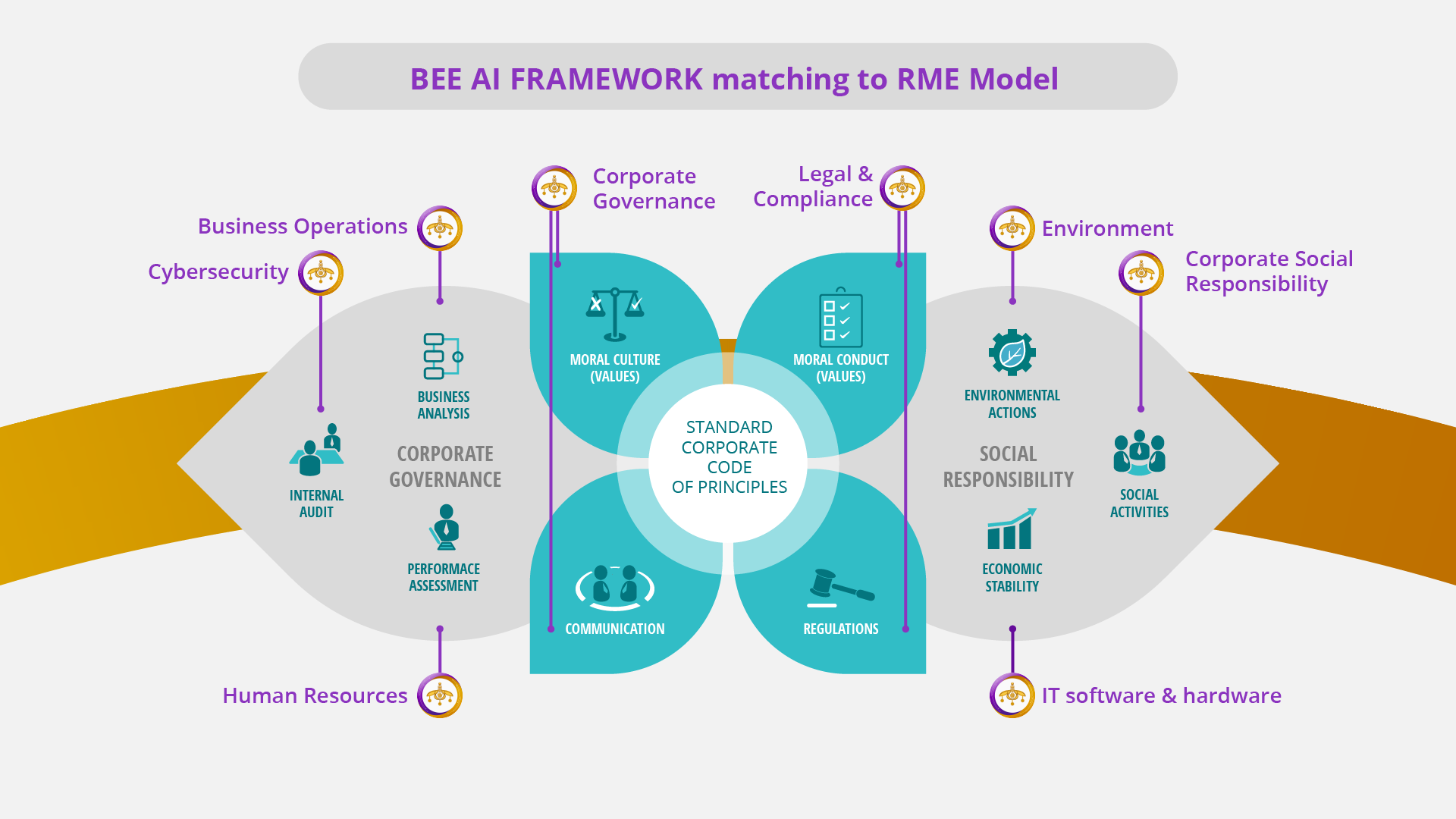
The model is structured across eight main sectors, each containing five subsections of actionable guidelines for corporate excellence:
-
-
- Corporate Governance: Focusing on ethical AI oversight boards and transparency in decision-making.
- Legal & Compliance: Aligning with international regulations like the EU AI Act and protecting consumer rights.
- Business Operations: Ensuring AI supply chain transparency and ethical sales practices.
- Cybersecurity: Mandating training data encryption and defenses against adversarial AI attacks.
- Human Resources: Implementing reskilling programs for workforce transition and bias-free recruitment audits.
- Environment: Tracking carbon footprints and implementing e-waste reduction strategies.
- Corporate Social Responsibility: Prioritizing AI projects for social good and combating AI-generated misinformation.
- IT Software & Hardware: Promoting sustainable hardware design and interoperability standards to avoid vendor lock-in.
-
Strategic Benefits and Return on Investment (ROI)
Implementing the BEE AI Framework provides measurable advantages that enhance a company’s competitive edge. According to the sources, organizations can achieve a 40% reduction in compliance issues (such as GDPR risks) and 15% energy cost savings in IT infrastructure. Furthermore, ethical AI practices boost stakeholder loyalty, improve employee retention by 20%, and attract sustainability-focused (ESG) investors.
The Optimization Path Roadmap
Progress toward AI excellence is measured on a 400-point scale, divided into five maturity levels:
-
-
- Foundation (10–45 points): Basic knowledge of AI potentials and its use for simple task assistance.
- Advanced (50–95 points): Established AI culture and the use of AI in personal or existing software.
- Bronze & Silver Ace (100–295 points): Proof of AI application development and the use of multi-models or agents for advanced applications.
- Gold Ace (300–400 points): The “Competitive Advantage Tier” where the company runs almost fully on AI-assisted systems and personnel possess high-level AI expertise.
-
Certification and Participation
The European Business Ethics Network (EBEN), a non-profit organization representing 18 countries, supports the diffusion of these values and moral leadership. Organizations can apply for assessment to be honored with the AI Excellence Award. Participation costs are scaled by company size.
RME CERTIFICATION BY CRITERION
It concerns public and private sector organisations that wish to be certified in specific areas in which they focus, such as Social Responsibility, Internal Audit, etc.